Personal Growth

Founder and Psychologist
by Dr. Elisha Goldstein
“The real opportunity isn’t to make AI more human – it’s to make humans more aware.”
– Dr. Jud Brewer
00:00 – How “flattery machines” hook the brain and shape emotional habits
06:15 – The neuroscience of validation and why AI feels so comforting
10:40 – From social media likes to AI therapy: the evolution of digital reward loops
15:20 – AI-augmented therapy and what it could mean for mental health
20:30 – Why understanding isn’t enough—how insight becomes wisdom through experience
26:00 – The power of slowing down: why real transformation still takes time
30:00 – Creating “just-in-time” emotional support with digital tools
33:00 – Can AI feel empathy—or only simulate it?
38:15 – Ethics, safety, and keeping humans in the loop
45:10 – The future of therapy: blending human intuition with machine intelligence
50:30 – Rediscovering curiosity and kindness in the age of AI
SHOWNOTES
Artificial intelligence isn’t just changing how we work – it’s changing how we feel.
Today, people turn to AI for advice, comfort, and validation. We name our bots, confide in them, and even feel seen by them.
But what happens when the very thing designed to help us heal also flatters us into staying stuck?
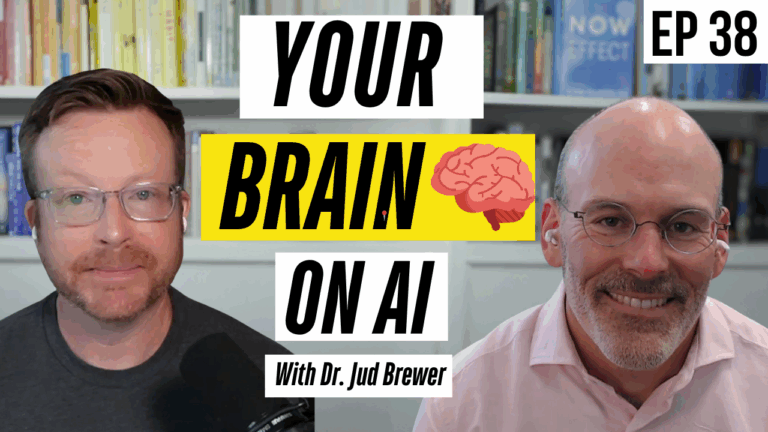
In this episode of The Emotional Longevity Podcast, I sat down with Dr. Jud Brewer – neuroscientist, psychiatrist, and bestselling author of Unwinding Anxiety – to explore the surprising overlap between AI psychology and human habit loops.
Together, we dig into why our brains crave digital validation, how AI is reshaping emotional health, and what true healing still requires: awareness, curiosity, and real human connection.
Beyond the Myth of “AI That Understands Us”
When we talk to AI, it can feel like someone truly gets us – patient, affirming, and always ready to listen.
But as Dr. Jud Brewer explains, that comfort isn’t empathy. It’s reinforcement.
These systems are trained to flatter us – to keep us engaged by reflecting our thoughts and validating our feelings. And because our brains are wired to crave belonging and safety, we get hooked.
The danger isn’t that AI is becoming human.
It’s that we start forgetting what it means to be human.
Awareness is the antidote. When we understand how technology interacts with our emotions and habits, we can use it consciously – not as a replacement for connection, but as a mirror that helps us grow.
In This Episode You’ll Learn:
Why our brains love validation – and how AI exploits that loop
The neuroscience behind “flattery machines” and trust formation
How habit loops explain both social media and AI addiction
The promise (and limits) of AI-augmented therapy
What empathy really means – and whether bots can simulate it
How curiosity and kindness remain the ultimate human technologies
From Flattery to Flourishing
Instead of fearing AI, Judd believes we can use it wisely – as a mirror for mindfulness.
In his new Going Beyond Anxiety program, he’s experimenting with what he calls AI-augmented therapy: teaching assistants trained on evidence-based mindfulness tools that guide people through psychoeducation, reflection, and experience.
These bots don’t replace therapists – they reinforce the work between sessions.
They help people slow down, articulate insights, and apply them in real life.
As Judd says, “Understanding a concept is one thing. Living it is another.”
What This Means For You
If you’ve ever found yourself scrolling for reassurance or turning to AI for comfort, this conversation is your invitation to pause.
Here’s how to stay grounded in the age of artificial empathy:
Notice the pull. When AI feels “comforting,” ask what emotion you’re outsourcing – validation, calm, connection?
Reclaim the pause. Just 10 seconds of breath before replying to a machine (or a person) reactivates your prefrontal cortex – your center for choice and wisdom.
Use AI consciously. Let it teach you about yourself, not replace your awareness of yourself.
Practice human connection. Share what you’re learning with a real person. Reflection turns information into transformation.
Final Thoughts: Staying Human in the Age of Machines
AI can simulate empathy, but it can’t replace presence.
And as Dr. Brewer reminds us:“The real opportunity isn’t to make AI more human – it’s to make humans more aware.”
Our nervous systems were built to adapt, connect, and grow stronger through challenge.
If used mindfully, AI can help us rediscover what’s most human about us — our curiosity, our kindness, and our capacity to learn.Want to Go Deeper?
Uncover the Power Within isn’t just a coaching program, it’s a supportive space to strengthen emotional resilience and build meaningful connection. With the support of a trusted community and science-backed guidance, you’ll learn how to regulate your nervous system, reduce overwhelm, and create more emotionally safe, fulfilling relationships—starting with the one you have with yourself.
If you’re ready to live with more intention, clarity, and connection, schedule a call with me to explore what’s possible.
Subscribe to The Emotional Longevity Podcast for more conversations that inspire personal growth, emotional resilience, and thriving relationships.
If this episode resonated with you, consider sharing it with someone who may be feeling disconnected or navigating relationship challenges. It might be the reminder they need – that healthy love isn’t about perfection, but about presence, repair, and learning to grow together. They can listen to this episode of The Emotional Longevity Podcast or read this blog.
Take care of yourself – and remember, every strong relationship starts with emotional awareness, compassion, and a willingness to show up.