Personal Growth

Founder and Psychologist
by Dr. Elisha Goldstein
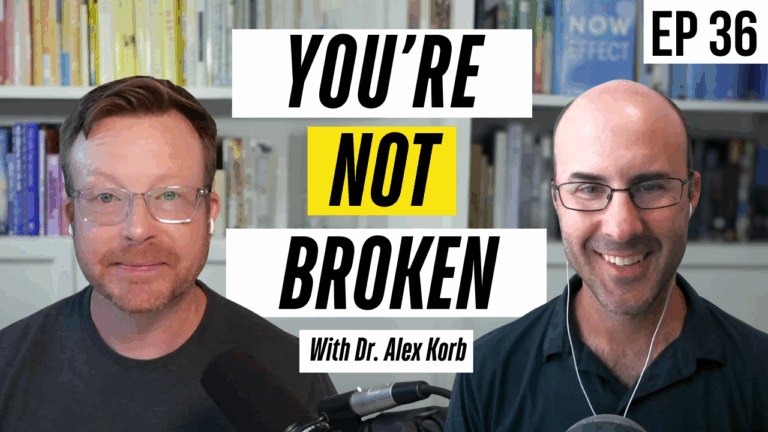
“There’s nothing wrong or broken about the brain in depression.
It’s a pattern that arises from circuits we all have – and patterns can change.” – Dr. Alex Korb
00:00 – Why depression and anxiety are not signs of a “broken” brain
06:15 – The teenage spiral: what our first social anxieties teach us about reactivity
12:40 – How emotional depth and sensitivity can become strengths
18:00 – What actually happens in your brain during a downward spiral
23:00 – The habit circuits that keep us stuck — and how to rewire them
30:00 – The science of self-compassion and acceptance
36:00 – Why thinking your way out of stress doesn’t work
42:00 – The “dumb stuff” that actually heals your brain (sleep, food, light, and movement)
49:00 – How choice, control, and kindness change your biology
56:00 – One small change that can start your own upward spiral
SHOWNOTES
When it comes to emotional health, most people think they’re broken – that something deep inside them needs to be fixed. But what if you’re not broken at all? What if your brain is simply running a pattern that can be changed?
In this episode of The Emotional Longevity Podcast, I sat down with Dr. Alex Korb, neuroscientist and author of The Upward Spiral, to explore how depression, anxiety, and burnout aren’t signs of failure – they’re signs of your brain doing what it’s wired to do.
Together, we unpack how understanding your brain’s emotional loops can help you break free from self-criticism, rewire negative patterns, and create the upward spiral toward calm, confidence, and connection.
Beyond the Myth of The “Broken Brain”
When you’re stuck in a cycle of anxiety, depression, or burnout, it can feel like your brain is damaged – like something in you just doesn’t work.
But as neuroscientist and author Dr. Alex Korb explains, that story isn’t true.
The brain isn’t broken.
It’s caught in a pattern – a loop between thinking, feeling, and action circuits that accidentally keeps us stuck.
And that means it can change.
Through humor, personal stories, and over a decade of research behind his book The Upward Spiral, Dr. Korb shows that understanding your brain’s dynamics isn’t just interesting – it’s liberating.
When you realize your stress response, overthinking, or emotional reactivity are built-in human features (not flaws), compassion and curiosity can replace shame.
In This Episode You’ll Learn:
-
Why your emotions and thoughts feed each other – and how to break the cycle
-
What happens inside the brain during a “downward spiral”
-
How awareness alone can start an upward spiral
-
The role of self-criticism and why it keeps you stuck
-
Why small “dumb” actions (sleep, light, food, and movement) aren’t dumb at all
-
The neuroscience behind acceptance and self-compassion
-
How choice, curiosity, and kindness reshape your brain chemistry
From Self-Criticism to Curiosity
Most people think self-criticism helps them change.
But as Alex explains, criticism is just another habit loop – the brain’s misguided attempt to keep you safe.
Replacing “Why do I keep doing this?” with “I wonder why I keep doing this?” shifts your brain from judgment to discovery.
That small change activates the prefrontal cortex, quiets the amygdala, and opens the door to insight instead of shame.
Understanding this process – that even your harshest thoughts have biological roots – helps you step back, breathe, and work with your brain rather than against it.
What This Means For You
If you’ve ever felt stuck in overthinking, burnout, or self-criticism, this episode is your reminder: you’re not broken – your brain is simply following old patterns that can be rewired.
Here’s what you can start practicing today:
-
Name the pattern. When you catch yourself spiraling, pause and say, “This is my worry loop” or “This is my self-criticism circuit.” Naming it separates you from the habit.
-
Bring curiosity instead of blame. Shift from “What’s wrong with me?” to “Why might my brain be reacting this way?” Curiosity opens the door to change.
-
Start small. Tiny actions – like getting sunlight, moving your body, or expressing gratitude – begin to nudge your brain chemistry upward.
-
Practice compassion. Talk to yourself like you would to a friend who’s struggling. Your brain learns safety and motivation through kindness, not criticism.
Emotional health isn’t about perfection – it’s about learning how your brain works and working with it, not against it.
-
Final Thoughts: The Upward Spiral Begins with Awareness
-
Healing doesn’t come from finding what’s wrong with you.
It comes from understanding how your brain works – and using that knowledge to choose one small, compassionate action at a time. -
As Dr. Korb reminds us,
“Learning about your brain isn’t about fixing yourself.
It’s about realizing you were never broken –
and discovering the simple, science-backed ways to go up again.”
Want to Go Deeper?
Uncover the Power Within isn’t just a coaching program, it’s a supportive space to strengthen emotional resilience and build meaningful connection. With the support of a trusted community and science-backed guidance, you’ll learn how to regulate your nervous system, reduce overwhelm, and create more emotionally safe, fulfilling relationships—starting with the one you have with yourself.
If you’re ready to live with more intention, clarity, and connection, schedule a call with me to explore what’s possible.
Subscribe to The Emotional Longevity Podcast for more conversations that inspire personal growth, emotional resilience, and thriving relationships.
If this episode resonated with you, consider sharing it with someone who may be feeling disconnected or navigating relationship challenges. It might be the reminder they need – that healthy love isn’t about perfection, but about presence, repair, and learning to grow together. They can listen to this episode of The Emotional Longevity Podcast or read this blog.
Take care of yourself – and remember, every strong relationship starts with emotional awareness, compassion, and a willingness to show up.